
 English


Views: 0 Author: Site Editor Publish Time: 2025-09-26 Origin: Site


Industrial automation is rapidly reshaping manufacturing, logistics, and production environments. From robotic assembly lines to automated inspection systems, the efficiency and reliability of these systems depend on seamless electrical connectivity. At the heart of this connectivity lies a critical yet often overlooked component: the wiring harness.
A wiring harness is more than just a bundle of wires; it is a meticulously engineered assembly that organizes and protects electrical circuits, ensuring that signals and power are delivered efficiently across complex automated systems. In industrial automation—where downtime is costly and precision is essential—wiring harnesses serve as the backbone of reliable operation.
A wiring harness, sometimes referred to as a cable assembly, is a systematic arrangement of wires, connectors, and protective components. Its primary purpose is to transmit electrical signals and power between devices or system components. Unlike loose wiring, a harness consolidates multiple cables into a single, organized unit, reducing complexity and enhancing safety.
Key components of a wiring harness include:
Conductors (wires and cables): Carry power and signals.
Connectors: Facilitate quick and secure attachment to equipment.
Protective sheathing: Guards against abrasion, moisture, and chemicals.
Insulation materials: Prevent short circuits and ensure electrical safety.
Labels or markers: Simplify installation and maintenance.
In industrial automation, where systems can involve thousands of connections, a wiring harness is indispensable for maintaining clarity and reliability.
Automation systems demand precision, consistency, and durability. Wiring harnesses deliver these benefits in several ways:
Instead of installing each wire individually, technicians can install a pre-assembled harness, significantly reducing installation time and errors.
Harnesses keep cables organized and shielded, preventing electrical hazards, accidental disconnections, or damage due to vibration and movement.
Industrial settings often involve dust, chemicals, high temperatures, or mechanical stress. Harnesses protect wires from environmental hazards, ensuring long-term reliability.
Clear labeling and organized layouts make it easier for technicians to troubleshoot and repair systems, minimizing downtime.
Harnesses can be custom-designed to meet the unique demands of automation equipment, from small robotic arms to large conveyor systems.
Wiring harnesses are indispensable in modern industrial automation, serving as the lifeline for power and signal transmission across diverse applications. By ensuring organized, durable, and interference-free connectivity, they enable automation systems to function at peak performance. Below are some of the most critical areas where wiring harnesses play a decisive role:
Industrial robots require highly reliable electrical connections to coordinate the movement of motors, sensors, and controllers. A well-designed harness accommodates repetitive motion and bending without causing cable fatigue or breakage. This flexibility is crucial in robotic arms, which often operate under continuous cycles in assembly lines. By minimizing wear and ensuring signal stability, wiring harnesses contribute to uninterrupted robotic performance and reduced downtime.
Automation control panels serve as the nerve centers of industrial systems, housing PLCs, relays, drives, and power supplies. Harnesses keep the dense wiring inside these panels organized and standardized. This not only simplifies installation but also makes troubleshooting and system upgrades faster and safer. Clean, structured wiring is essential to prevent short circuits and maintain compliance with safety standards.
In material-handling operations, conveyors depend on motors, limit switches, and proximity sensors to operate smoothly. Wiring harnesses integrate these components while protecting against mechanical stress and accidental entanglement. By reducing cable clutter, harnesses improve both system reliability and worker safety.
High-speed cameras, lighting units, and processors require stable and interference-free connections to deliver accurate results. Harnesses designed with shielding and grounding features minimize electromagnetic interference (EMI), ensuring precise signal transmission. This reliability is particularly important in quality control systems, where faulty signals could lead to production errors.
Industrial automation prioritizes worker and equipment safety. Emergency stop buttons, alarms, and sensor networks rely on fail-safe wiring to function without delay. Harnesses provide tamper-resistant and secure connectivity, ensuring that safety features activate instantly when needed. Their durability also reduces the risk of wiring failure in critical scenarios.
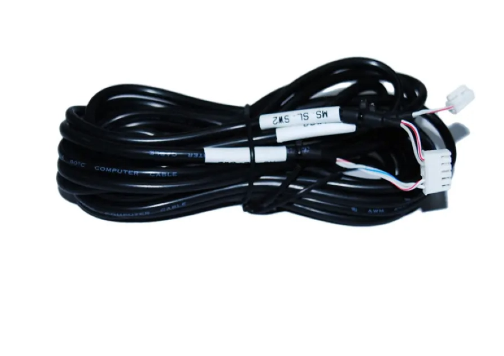
Designing a wiring harness for industrial automation involves balancing performance, safety, and cost. Key considerations include:
Conductors: Copper for conductivity and durability.
Insulation: Heat- and chemical-resistant materials like PVC, Teflon, or silicone.
Sheathing: Braided, corrugated, or over-molded options depending on application.
Harnesses must withstand vibration, bending, and flexing. Strain relief features and flexible conduit designs extend service life.
Harnesses often require IP-rated protection against dust and water, ensuring reliable operation in harsh industrial settings.
Shielded cables and grounding methods prevent EMI, which is critical in automation systems where signal accuracy is vital.
Every automation project is unique. Harnesses must be custom-designed to match specific machine layouts, connector types, and functional requirements.
Beyond simplifying wiring, harnesses contribute to overall operational efficiency:
Reduced Downtime: Quick replacement or repair due to modular design.
Improved Productivity: Less wiring-related failure means fewer disruptions.
Lower Costs: Savings on labor during installation and reduced maintenance expenses.
Greater System Longevity: Protection from environmental and mechanical stress extends system life.
Despite their benefits, wiring harnesses face challenges in industrial automation:
Excessive current can cause overheating. Proper conductor sizing and thermal protection prevent failures.
Constant motion, especially in robotics, can wear out harnesses. Using flexible cables and protective sleeves mitigates this risk.
Harnesses exposed to oils, solvents, or cleaning agents require specialized sheathing to resist degradation.
Large automation systems involve thousands of connections. Clear labeling, color coding, and standardized connectors simplify complexity.
As automation technology evolves, wiring harnesses are adapting:
Harnesses may incorporate embedded sensors for temperature, current, or vibration monitoring, supporting predictive maintenance.
Pre-configured harnesses that allow quick connection and reconfiguration will speed up system assembly.
Sustainable insulation and recyclable materials are becoming priorities in harness design.
With the rise of Industrial Internet of Things (IIoT) and AI-driven automation, harnesses must support high-frequency data transmission with minimal interference.
In the world of industrial automation, wiring harnesses are more than just connectors—they are the circulatory system of modern machines. By simplifying wiring, protecting against harsh environments, and ensuring reliability, harnesses enable automation systems to perform at their highest potential.
As industries embrace smarter, more connected automation solutions, the importance of well-designed wiring harnesses will only grow.
For organizations seeking advanced wiring harness solutions tailored to industrial automation, Guangzhou City Youye Electronics Co., Ltd. stands out as a trusted partner. With expertise in designing and manufacturing high-quality harnesses, they provide reliable connectivity solutions that support the efficiency and safety of modern automation systems.
To learn more about wiring harness solutions for your automation projects, consider exploring the offerings from Guangzhou City Youye Electronics Co., Ltd.—a company committed to advancing connectivity in industrial automation.